Katt Williams: Golf's Greatest Ambassador Today
Barrett Edri
April 30, 2026
The PGA Tour spent decades trying to make golf feel relevant. Then they put Katt Williams inside the ropes, and the game finally said something true.
The PGA Tour has spent decades and considerable resources trying to figure out how to make professional golf feel relevant to an audience that was not already watching it. They have hired marketing agencies. They have redesigned broadcast formats. They have launched social media accounts, partnered with YouTube creators, invited celebrities to pro-ams, and generally done everything a large, traditional sports institution does when it senses that the world is moving faster than its brand. Some of it has worked. Most of it has produced content that feels exactly like what it is, a large, traditional sports institution trying to be something it is not.
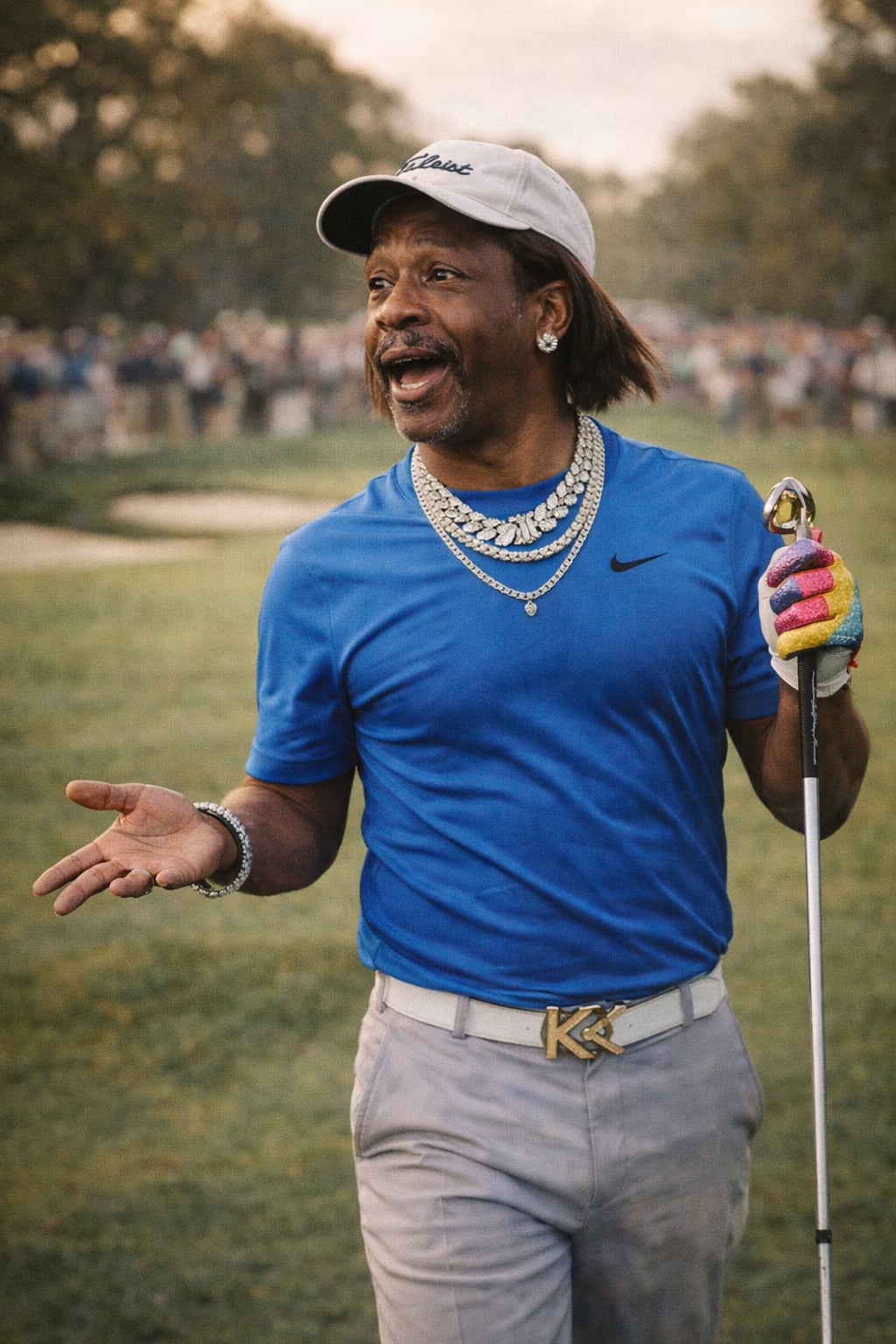
And then, in the summer of 2024, they sent Katt Williams inside the ropes at the FedEx St. Jude Championship as an on-course correspondent. And golf finally said something true.
The PGA Tour did not arrive at this decision by accident. They watched what was happening on social media. They watched the clips of Katt Williams talking about golf travel through the internet with the specific velocity that only genuine, unfiltered human expression produced and understood, with whatever institutional wisdom they could muster, that this man was doing something for the game that no official ambassador program had ever managed. He was making golf feel like it belonged to everyone. Not through a marketing campaign. Not through a produced piece of content with a budget and a creative brief. Through the simple, extraordinary act of talking about the game the way someone talks about something they actually love.
Katt Williams loves golf. Not as a hobby. Not as a celebrity accessory. As a calling. And the difference between those things is the difference between content that performs and content that resonates, and Katt Williams resonates at a frequency that the game has been trying to find for years.
What He Actually Says The quotes are the thing. The reason Katt Williams became golf's most effective ambassador is not his celebrity status, plenty of celebrities play golf and generate approximately zero cultural momentum for the game in doing so. It is what he says when he talks about it, which is some of the most precise, honest, and genuinely funny golf philosophy anyone has produced in any format.
"Golf is a game with morals. There's always an opportunity to be a scoundrel. That's why it's a gentleman's game." Read that sentence twice. That is a more accurate and more entertaining description of golf's essential character than anything the USGA has ever published. The game is built on the honor system. The permanent availability of the scoundrel's choice and the permanent significance of choosing not to take it. Katt Williams understood this and said it in one sentence. Golf Digest has entire books on this subject.
"Golf gives you the opportunity to do something exactly how the best player in the world would do it, and then six minutes later, you hit a shot like a nine-year-old." Every golfer alive has lived inside that sentence. The specific, bewildering gap between the shot that makes you feel like a professional and the shot that makes your playing partners quietly look away. That gap is the whole game and Katt named it with the precision of someone who has been standing in it for years.
And then there is this one, which arrived during an interview and which should be carved into the entrance of every driving range in America: "The first four holes not going to your liking? It has the ability to ruin the day, but it doesn't have to. You can fix this front nine, you see? And level this front nine out to where you can still have a good 18." That is not stand-up comedy. That is golf psychology. That is Harvey Penick with better timing. That is the mental framework that every golfer spends years trying to build. The refusal to let a bad start become a bad round, the understanding that the course is always recoverable, the stubborn insistence on presence over scorekeeping, delivered casually, as if it is the most obvious thing in the world. Because to someone who genuinely loves golf, it is.
He describes himself, when asked about his handicap, as "unhandicapped." Not zero. Not scratch. Unhandicapped. It is the most Katt Williams answer to a golf question that has ever been given, and it is also, in its own way, philosophically perfect. Because the best version of golf is the one played without the weight of a number defining what you are supposed to be capable of. The unhandicapped golfer plays the shot in front of them. Nothing more. Nothing less.
Why This Makes Him a Bigger Star Than Kevin Hart Kevin Hart is one of the most famous entertainers on the planet. He is also, as of September 2025, a brand new golfer. He posted his first round on Instagram with the caption: "First time on a golf course… Give me some time… S–t is about to get real." Fans responded by pointing out, cheerfully and repeatedly, that he is very short and standing very close to the ball. He posted a video of Bryson DeChambeau as his caddie. The content was funny. It was entertaining. It generated likes and comments and the kind of social media activity that publicists track in spreadsheets.
It did not make anyone love golf.
The distinction is important and it is the whole argument. Kevin Hart's golf content is celebrity content that happens to involve golf. Katt Williams' golf content is golf content that happens to involve a celebrity. One of those things grows an audience for the person. The other grows an audience for the game. Kevin Hart doing golf is Kevin Hart doing what Kevin Hart does, being entertaining, being accessible, being the version of himself that the internet rewards with engagement metrics. It is about him. It should be. He is very good at it.
Katt Williams talking about golf is about golf. The game itself. The morals of it, the humility of it, the specific psychological warfare it conducts against the person who loves it most. When Katt speaks about golf, the game is the subject. He is just the person standing closest to the truth of it and saying it out loud. That is not a smaller thing than what Kevin Hart does. It is a completely different thing. And for golf specifically, a game that has been waiting for someone to speak its language to an audience that did not already speak the native tongue. It is the more valuable thing.
The PGA Tour understood this when they put Katt inside the ropes. Not Kevin Hart. Not a produced celebrity segment with a script and a teleprompter. Katt Williams, unfiltered, inside the ropes, talking about golf the way someone talks about something that changed them. The TikTok the Tour posted got 69,000 likes and 700,000 views. Not because people wanted to see a celebrity at a golf tournament. Because people wanted to hear someone talk about golf like it mattered.
The OG in the Room: Anthony Anderson Before we talk about who is just arriving at the game, we need to give proper respect to the man who has been here for 25 years and whose commitment to golf's cultural expansion has been as consistent and as genuine as anyone in entertainment.
Anthony Anderson picked up a club at 21 or 22 years old when his father-in-law put one in his hand in San Diego. His father-in-law was a natural lefty but only had one right-handed club available that day. Anderson took a swing. He has not stopped since. Twenty-five years later he is one of the best celebrity golfers alive, placing himself, accurately and without apology, in the same conversation as Samuel L. Jackson and Don Cheadle when asked to name the top celebrity players. He describes his own handicap with the same comfortable honesty Katt Williams brings to the "unhandicapped" answer: "that's sort of his handicap these days," Golf Magazine wrote, the implication being that Anderson's 25 years of work has brought him to a place where the number is less important than the game itself.
What makes Anthony Anderson the OG of this conversation is not just the longevity. It is what he has done with it. The Anthony Anderson Celebrity Golf Classic is now in its seventh year, hosted annually at BIGHORN Golf Club in Palm Desert. One of the most prestigious private venues in California, home to courses designed by Arthur Hills and Tom Fazio, a club that has hosted Jack Nicklaus and Tiger Woods and Annika Sorenstam. Anderson's tournament has raised over $500,000 for charity, supporting youth education, health, wellness, and mentorship programs rooted in the communities of Watts and Compton where he grew up. The guest list reads like a who's who of Black excellence in American entertainment and sports. Don Cheadle, Cedric the Entertainer, Gary Payton, Ozzie Smith, DL Hughley, Dennis Haysbert, Julius Erving, Sterling Sharpe, assembled not for a photo opportunity but for two days of serious golf in service of something larger than the scorecard.
Anderson said in an interview: "It's just a pleasant trip through nature, just a leisurely stroll. It's my chance to get out and to turn off whatever I'm doing at the time." That is 25 years of the game speaking. That is someone who found what golf gives back to the person who gives themselves to it, and who has spent a quarter century passing that discovery on to everyone in his orbit.
He also said his golf hero is John Daly because they are about the same body type and Daly is a good friend. No notes.
The New Obsessives and the Distance They Have to Travel LeBron James is obsessed with golf. He has said so himself, posted about it, challenged Kevin Hart to a match, and generated enough social media content around the game to constitute a minor cultural moment all on its own. Dwyane Wade made a hole-in-one at the 7th hole at Pebble Beach. LeBron's swing has been described, charitably, as a work in progress. Steph Curry called him "a very good project to have" which is the most diplomatic assessment of a golf swing in recorded history.
These are men in the early chapters of their golf story. The obsession is real. The commitment is visible. The game has clearly gotten into them in the way it gets into everyone who gives it a genuine chance. Demanding everything and offering something back that nothing else quite replicates. LeBron and Wade discovering golf in the back half of their athletic lives is exactly the kind of story the game needs more of. It is the game reaching into corners of the culture it has historically not reached and finding the same response it has always found: complete surrender to something that turns out to be more profound than it looked from the outside.
But they have a ways to go to catch up to the OGs. Twenty-five years of Anthony Anderson, the quiet mastery of Ray Allen's plus handicap, the institutional knowledge that Samuel L. Jackson has been building on golf courses since before LeBron was in high school. The game respects longevity. It rewards the years you have given it with a specific kind of fluency, not just in the swing, in the philosophy of the game, the understanding of what it is asking of you on any given day and why. LeBron and Wade are beginners in the best possible sense of the word. The game has them now. They will not get away.
What Golf Has in Katt Williams That It Has Never Had Before Golf has had celebrity players forever. It has had celebrity ambassadors, celebrity pro-ams, celebrity Instagram accounts, celebrity partnerships with Tour events. It has had Kevin Hart caddieing for Bryson DeChambeau. It has had Bill Murray wandering into strangers' parties on Wednesday nights at Pebble Beach and somehow making that part of the official golf experience. It has had more celebrities on golf courses than any other sport in American life.
What it has not had, until Katt Williams, is a celebrity who talks about the game with the specific combination of love, humor, and philosophical precision that makes a person who has never touched a club want to understand what all the fuss is about. Not just wanting to watch golf. We need to understand it. Need to know what it feels like to stand over a shot with everything you have been told about the swing and everything the game is asking of you in that moment and exhale and trust what you know and let the club do what the club does. Want to feel what Katt feels when he walks off a course and says the front nine was recoverable and he leveled it out and had a good 18.
That is the ambassador golf needed. Not the celebrity who plays golf as content. The golfer who happens to be a celebrity. The man who talks about the game the way someone talks about something that changed the way they see everything else. The man who walks inside the ropes at a PGA Tour event and makes 700,000 people watch a clip about golf because something in the way he talks about it reaches them before they even know what hit them.
Golf is a game with morals. There's always an opportunity to be a scoundrel. That's why it's a gentleman's game.
Katt Williams said that. The game has been trying to say it for 500 years.
Foresome.com
Written by
Barrett Edri
Co-Founder, Foresome