The Feeling of Greatness, The Moe Norman Story
Barrett Edri
April 30, 2026
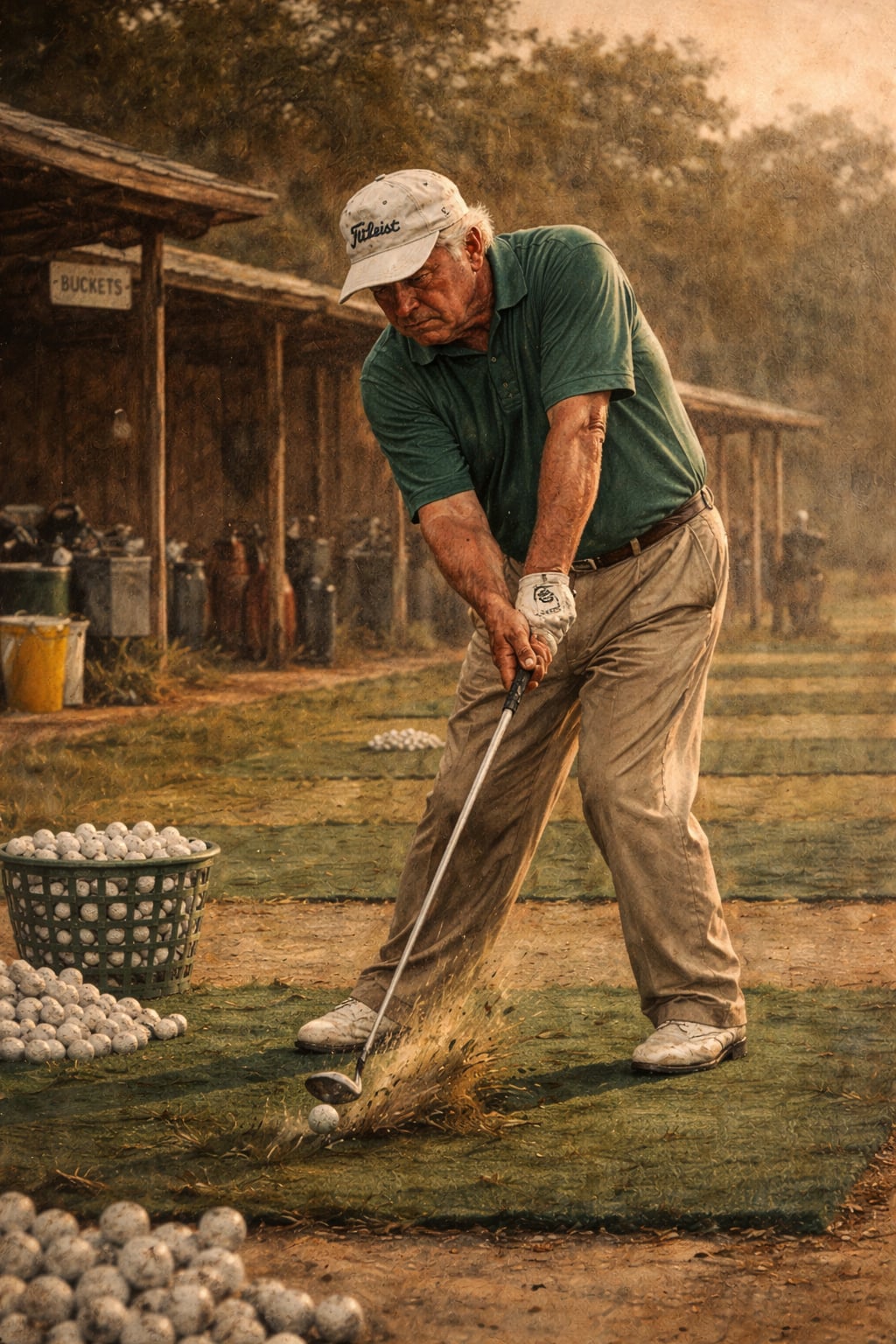
Tiger said only two golfers ever truly owned their swings: Hogan and Moe Norman. The greatest ball-striker who ever lived spent half his career sleeping in his car.
The Feeling of Greatness, The Moe Norman Story You have never heard of the greatest ball-striker who ever lived.
That sentence is worth sitting with for a moment, because it is not an exaggeration and it is not a rhetorical device. It is simply true. The man who Tiger Woods said, along with Ben Hogan, was one of only two golfers in history to have truly owned their swing. The man Sam Snead called the greatest striker of the ball he had ever seen. The man Lee Trevino described as a legend with the professionals and a genius when it comes to playing the game of golf. The man who shot 59 three times, made 17 holes-in-one, won 65 Canadian Tour events, set 33 course records, and could hit 20 consecutive balls to a target so tight you could cover all of them with an apple crate.
His name was Murray Irwin Norman. Everyone called him Moe. He died in 2004 in a hospital in Kitchener, Ontario, with a Titleist driver placed in his coffin and over $20,000 in cash found hidden throughout his car, because Moe Norman did not trust banks, alongside more than 1,000 loose golf balls, most of them Titleist Pro V1s, and 10 pairs of golf shoes.
He spent a significant portion of his professional life sleeping in his car. He set pins in a bowling alley in winter so he could play golf in summer. He slept in sand traps during tournaments because he could not afford a room. He wore long-sleeved shirts buttoned to the chin in any weather, in pants that never fit quite right, and the other professionals laughed at him and teased him and made him understand, with the casual cruelty that institutions deploy against people who don't fit, that he was not the kind of person professional golf was designed for.
He was also, without question, the most gifted ball-striker the game of golf has ever produced. And the game looked the other way for most of his life.
The Boy From Kitchener Moe Norman was born on July 10, 1929, in Kitchener, Ontario, the third of six children in a family that did not encourage his interest in golf. As a child he was hit by a car while riding his bicycle, a head injury that left him with lasting effects and that his biographer Tim O'Connor believes contributed to the specific neurology that made him who he was. He started caddying at Rockway Golf Course as a preteen, carrying bags for the kind of people who belonged to golf clubs while he slept in sand traps during away tournaments and hitchhiked from one event to the next.
From the beginning there was something different about the way Moe Norman related to a golf club. Not different in the way that requires explanation, different in the way that makes other people stop and stare and forget what they were doing. He practiced until his hands bled. Literally bled. He built up calluses so thick he had to cut them off with scissors, the sharp edge of them capable, he noted, of drawing blood if dragged across a person's face. He hit golf balls the way people breathe, constantly, naturally, compulsively, as if the repetition itself was the point rather than the preparation for something else. For Moe Norman, the repetition was the point. The feeling of a ball struck purely was, in his own words, spiritual. It was the feeling of greatness. That phrase, his phrase, the one he used to describe what a perfect shot felt like, became the title of his biography and the most accurate summary of what drove him that anyone ever found.
He hit so many balls that he developed his own swing to accommodate the volume. Not to look orthodox. Not to satisfy an instructor's checklist. To be able to hit golf balls, perfectly and repeatedly, for as long as his body would allow. The result, rigid arms extended far from the body, a very wide stance with minimal knee bend, a shorter-than-usual backswing, an extended follow-through with minimal hand action, became known as the Single Plane Swing. It looked nothing like what the instruction manuals described. It looked nothing like what anyone else was doing. It worked better than anything anyone else was doing, and the proof was not theoretical. The proof was on the range, every day, in ball after ball after ball flying exactly where Moe Norman intended it to fly, with a consistency that made professional golfers stop their own practice sessions and walk over to watch in silence.
He was self-taught. He never took a lesson in his life.
What He Could Do The numbers are almost too clean to be believed, which is perhaps why the golf world spent so long declining to fully reckon with them.
Moe Norman shot 59 three times. In 1957, the year he turned professional, he entered 21 separate Canadian Tour events and won 17 of them. He won back-to-back Canadian Amateur Championships in 1955 and 1956, the only consecutive wins in the history of that event. He could recite the exact hole yardages for 375 of the 434 courses he played over his career. When he ran clinics, he would offer bets to the gallery: he could bounce a ball off the face of his driver more than 100 times, or he could hit a ball into a shirt pocket at a designated distance. He made both shots. He once hit the same target, a flagstick 150 yards away, nine times out of nine consecutive attempts. When a reporter asked him when was the last time he missed a fairway, Moe thought about it and said: about seven years ago.
One of the most famous Moe Norman stories involves a caddy who told him he could get to the green with a driver and a 9-iron. Naturally, Moe hit his tee shot with the 9-iron and reached the green with the driver. This was not showboating. This was Moe Norman's genuine, specific relationship with golf, a relationship in which the conventional wisdom about how the game should be played was always secondary to his own internal understanding of what was possible and what was interesting. He once putted for birdie on the final hole with a comfortable lead, missed intentionally, got up and down from the bunker to win by two, and told the people who had been betting on him and now approached him with drained faces: "I needed the variety."
He also had a caddy once walk to the hole he was playing and hold the flag vertically while Moe hit shot after shot toward him, not at the green, directly at the flag, because he wanted to see if he could hit the same spot repeatedly from 150 yards. He could.
Todd Graves, a PGA professional who spent a year trying to learn Norman's swing from a videotape before finally watching him in person at a driving range in Chicago in 1994, said it simply and completely: "I don't think I've ever seen anybody do what Moe could do to a golf ball, as far as the consistency of the flight, the windows he would hit the golf ball through." Graves went on to found the Graves Golf Academy, an institution devoted entirely to teaching Norman's single plane method. Over 200,000 golfers have been instructed in the Moe Norman swing. The man is gone. The swing endures.
What The Game Did To Him Here is where the story earns its full weight.
Moe Norman tried the PGA Tour. He was invited to the Masters in 1956 and 1958 as an amateur, which means he stood on Augusta National's first tee and played the most storied course in American golf before most of the people reading this were born. He turned professional in 1958 and showed the world what he could do. And the world, the specific, insular, tradition-bound world of professional golf in the late 1950s, looked at Moe Norman in his ill-fitting pants and his buttoned-to-the-chin shirt, watched him talk to spectators during tournament rounds and take bets from the gallery and play with a speed and an eccentricity that no one had seen before and no one quite knew what to do with, and decided that he was not the kind of person they wanted representing their game.
The bullying was real. The pros teased him. They made comments. They created an atmosphere that communicated, clearly and consistently, that Moe Norman was tolerated but not welcomed. He retreated to Canada, where he spent the rest of his professional career playing the Canadian Tour and building a legend that the American game barely acknowledged until it was almost too late.
He lived in poverty for much of this time. A motel room for $400 a month. His clothes in his car. His money hidden throughout the car because he did not trust banks. Winters setting pins at a bowling alley because the Canadian Tour had lost its sponsor and there was nothing else. In his late 20s, sleeping in sand traps during away tournaments because the prize money didn't cover a room. In his late 50s and early 60s, going through another hard stretch, sleeping in his car again. The greatest ball-striker who ever lived, going through decades of his career in conditions that would have broken anyone whose love for the game was anything less than total.
His love was total. That is the part of the story that does not break, the part that is almost unbearably moving when you sit with it fully. Moe Norman went through every indignity, every financial hardship, every cold night in a car on the way to another tournament that barely covered his expenses, and came out the other side of all of it saying: golf for him was a source of joy. Even in the days when he practiced until his hands bled. Even when the money was gone and the Tour had lost its sponsor and the next stop was another motel room or another sand trap. The joy was not contingent on the outcome. It was not contingent on the recognition. It was not contingent on the approval of an industry that had decided he was not their kind of golfer. The joy was in the swing. The feeling of a ball struck purely. The thrill of feeling it. Every muscle enjoyed that shot. That was what he got a kick out of.
That kind of love for a thing is rare in any field. In a person who was treated the way Moe Norman was treated by the game he loved, it is something close to sacred.
The Titleist Moment In the early 1990s, Moe Norman was at the PGA Merchandise Show in Orlando when Wally Uihlein, the president of Titleist and Acushnet, walked up to him at the Titleist booth. Moe had been wearing their visor, their FootJoy shoes, and playing their golf ball for 40 years. Uihlein asked him directly: has anyone done anything for you?
Moe told him nobody had done anything. That he had never asked.
Uihlein said: give me your hand. He shook it. And then he told Moe Norman that Titleist would pay him $5,000 a month for the rest of his life.
Moe stepped backward. He said: I've played your balls all my life. What do I have to do for that money?
Uihlein said: You don't have to do anything. You've already done it. We just want to thank you for what you've already done.
The man who was present, Jack Kuykendall, who had spent two years trying to get Moe Norman to meet with him and had finally broken through, said that by that point the hair was standing up on his arms and everyone in the room was about to cry. Moe went limp. He almost went into shock. Kuykendall thought he might pass down. They had a clinic to run immediately after, and in the car on the way there, Moe turned to Kuykendall and said: Jack, I don't know if I can hit the ball.
Moe Norman, the greatest ball-striker who ever lived, shaken so completely by a moment of genuine recognition that he was not sure he could swing a club.
Uihlein later described the contract as a reverse scholarship, the acknowledgment that Moe Norman had given something to the game of golf, through 40 years of loyalty and excellence and the quiet, daily genius of a swing that no one in the world could replicate, that deserved to be honored regardless of what the tournament record said or what the establishment thought of the man who produced it. It was, in the best sense of the word, justice. Forty years late. But justice.
Moe Norman opened his first bank account that year.
What Tiger Said In January 2005, four months after Moe Norman died, Tiger Woods sat down with Golf Digest's Jaime Diaz and said the thing that should have been said while Norman was alive to hear it.
Only two golfers in history have truly owned their swings. Moe Norman and Ben Hogan. I want to own mine.
Read that carefully. Not two of the greatest, most accomplished, most decorated golfers in history. Two golfers who owned their swings. Tiger Woods, the most dominant player of his era, the most decorated golfer of the modern age, placed Moe Norman, a Canadian tour player who spent decades sleeping in his car and setting pins in a bowling alley, in the same sentence as Ben Hogan as the only two golfers who had ever truly mastered the relationship between mind and club and ball that defines the swing at its highest level. Sam Snead said Norman was the greatest striker he ever saw. Lee Trevino said he was a legend and a genius. Ken Venturi called him one of golf's premier ball-strikers. These are not casual opinions. These are verdicts from the people most qualified to give them.
The game gave him nothing for most of his career. The greatest players who ever lived said he was the best at the thing the game is fundamentally about. Both of those things are true simultaneously, and the distance between them is the most honest indictment of golf's institutional character that exists.
The Legacy That Refuses to Stay Quiet Moe Norman died on September 4, 2004, at the age of 75, from congestive heart failure. He was inducted into the Canadian Golf Hall of Fame, the Ontario Sports Hall of Fame, and Canada's Sports Hall of Fame. The Graves Golf Academy, built entirely around his single plane method, has taught over 200,000 golfers. His swing has been viewed over two million times on the internet. A biography, The Feeling of Greatness: The Moe Norman Story by Tim O'Connor, has been updated and expanded and continues to find new readers. A documentary is in development. A feature film about his life has been discussed. The name keeps traveling.
What he said about the game, the quotes scattered through his interviews and clinics and the stories people who knew him have told for decades, holds up the way only things that are completely true hold up. Golf isn't supposed to be work. It's to have fun. Working on your swing is the greatest joy in golf. The thrill of feeling it. Every muscle enjoyed that shot.
He asked, when someone finally explained the biomechanics of his swing to him for the first time, after a lifetime of doing it: all my life I've wondered why I can do what I can do with a golf club. And you are the first person who ever explained it to me.
That sentence contains the whole story. A man who built the greatest golf swing the world has ever seen, who produced it entirely by himself through the sheer love of hitting golf balls until his hands bled, who never had anyone sit down with him and explain why it worked, why the thing he could do with a club was so far beyond what anyone else could replicate, who spent his entire career doing something extraordinary without ever fully understanding the mechanics of his own genius, finally hearing, in a hotel room at the end of his career, the explanation he had deserved from the beginning.
When the sun went down, Moe Norman went back to his motel room and turned on the TV. He was fine during the day because he could play golf. But at night he didn't know what to do.
The game was his whole world. It gave him almost nothing in return for most of his life and everything he had to give for all of it. He gave it anyway. He gave it joyfully, and stubbornly, and with the specific, unshakeable commitment of a man who had found the one thing in the world that made complete sense to him and was not going to let anyone take it away regardless of how hard they tried.
They tried. He stayed. He hit the ball. Every muscle enjoyed that shot.
That is Moe Norman. The greatest ball-striker who ever lived. The man you had never heard of until right now. The man the game still owes a proper reckoning.
Consider this a down payment.
Foresome.com
Written by
Barrett Edri
Co-Founder, Foresome