The Mt. Rushmore of Golf Movies
Barrett Edri
February 24, 2026
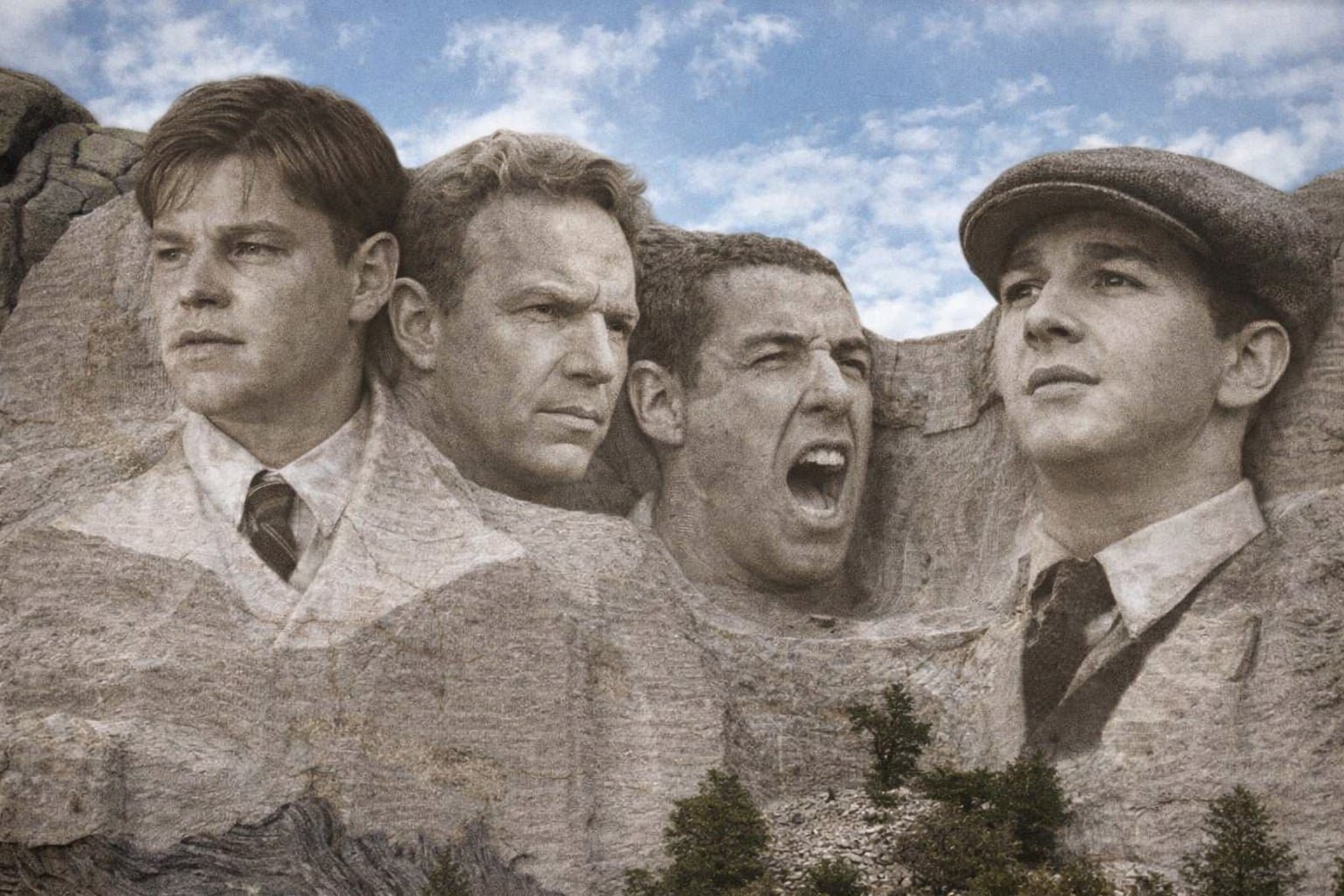
Four faces. Four legacies. One mountain.
There is a specific kind of joy that golf delivers to the people who love it most. It is not the joy of a crowd on its feet, or the chaos of a last-second comeback, or the roar of something explosive and fast. It is quieter than that. More patient. It is the joy of a ball struck perfectly, of a line held under pressure, of a moment where everything you believed about yourself turned out to be true. It is the joy of standing on a piece of land that is both a stage and a sanctuary, with nothing between you and the shot but everything you are.
Hollywood has been chasing that feeling for decades. Most attempts fall short. But a handful of films have gotten close enough to the truth of the game, close enough to the feeling of it, that golfers everywhere have adopted them as their own. Not just as entertainment, but as something more personal than that. As mirrors. As inside jokes. As love letters written in the specific language of people who understand what it actually means to play this game.
Mt. Rushmore was never about ranking the four faces carved into it. It was about permanence. About saying that these four things belong together on the same mountain, for different reasons, representing different truths, and that the mountain is not complete without any one of them. That is exactly what these four films are to the game of golf. Four faces. Four legacies. One mountain.
The Greatest Game Ever Played (2005)
There is a scene in The Greatest Game Ever Played where Francis Ouimet, a twenty-year-old amateur caddy from a working-class family in Brookline, Massachusetts, stands across from the greatest golfers in the world at the 1913 U.S. Open and does not blink. He should not be there. He is the least likely person in the field. He is playing against Harry Vardon, the dominant professional of his era, a man who had already won five British Opens, a man who invented the grip that bears his name. And yet.
This film is a biography, a period piece, and a genuinely moving underdog story, and it works because it takes golf seriously. It takes the specific drama of golf seriously, the quiet between shots, the weight of a single putt, the way one moment can contain an entire life's worth of meaning. Director Bill Paxton, working from a remarkable true story, understood that golf does not need to be dressed up to be cinematic. He simply let the game carry the weight, and it did.
Shia LaBeouf brings a quiet dignity to Francis Ouimet that earns every moment the film asks you to believe in him. And Stephen Dillane as Vardon provides the kind of noble, complicated antagonism that elevates the protagonist simply by being present, because beating someone with that much grace is its own kind of achievement. When Ouimet makes the winning putt in the playoff, you feel it not just as a golf shot but as a statement about who belongs in this game, who deserves to stand on its stages, and the answer, the film insists, is anyone who loves it enough to show up.
The Greatest Game Ever Played earns its place on the mountain because it is the game's origin story retold as cinema, a reminder that golf has always been bigger than its gatekeepers wanted it to be, that its stages belong to anyone with the courage to stand on them, and that the first time an amateur beat the world's best professionals, it happened because a young man from Brookline loved the game too much to be intimidated by it. That story belongs in stone. It always will.
Happy Gilmore (1996)
Happy Gilmore is not a movie about golf. It is a movie about all of us.
Every golfer alive has stood over a shot with the quiet, terrifying awareness that the correct swing is somewhere inside their body and they cannot find it. Every golfer has felt the gap between what they meant to do and what they actually did. Every golfer has, at some point, wanted to chase a golf ball down the fairway with murderous intent and throw their club into the nearest body of water. Happy Gilmore is simply the version of golf where someone actually does all of that, and we love him for it because the impulse is entirely real.
Adam Sandler's “Happy” is a failed hockey player who discovers, almost accidentally, that he can drive a golf ball the length of a small country using nothing but raw rage and a running start. He enters the PGA Tour. He does not fit. He does not care that he does not fit. And that gap between the genteel, quiet tradition of professional golf and this screaming, sprinting human wrecking ball is where the movie lives and where it absolutely thrives.
The pairing with Bob Barker, and that fight scene, which remains one of the great comedic action sequences in sports movie history, is a gift that keeps giving. The relationship with his teacher Chubbs is warm and funny and quietly loyal. Shooter McGavin, the tour's reigning villain, is one of the great antagonists in the genre, because his disdain for Happy is so complete and so personal that you understand immediately that what he really hates is not the disruption. What he hates is the joy. Probably because of what Shooter had for breakfast.
Because Happy plays golf with joy. Unfiltered, chaotic, ridiculous joy. And the movie knows, somehow, that this is what golf actually asks of us at its most fundamental level. Not perfection. Not conformity. Joy. That impulse, the joy of the swing, the joy of the game, the joy of being outside with a ridiculous little club trying to put a ridiculous little ball into a ridiculous little hole, is what Happy Gilmore is really about.
Happy Gilmore earns its place on the mountain not in spite of its chaos but because of it. Every golfer who has ever wanted to sprint into a swing, who has played their best golf when they stopped caring about the score and started caring about the shot, who has ever felt the game open up the moment they let go of trying to be something they're not, they know exactly what this movie is. It is the permission slip the game never officially issues but secretly endorses. It belongs in stone.
The Legend of Bagger Vance (2000)
The Legend of Bagger Vance is the most beautiful golf movie ever made. It is unhurried and lyrical and it asks you to sit with it, to let it work on you, the way a long walk on a quiet course asks you to let the game do what it wants to do instead of forcing it into something else. Robert Redford directed it with the patience of someone who understood that golf is not about the scorecard. It was never about the scorecard.
Will Smith brings to Bagger Vance a kind of wise, warm mystery that makes him feel less like a caddy and more like a message delivered to Randolph Junah at exactly the moment he was ready to receive it. Matt Damon's “Junah” is a man hollowed out by war and by the distance between who he was and who he became, and the film understands that golf, the specific, intimate, relentless game of golf, can reach into that hollow place and find something still alive. The game has always been capable of that. Ask anyone who has played through grief. Ask anyone who has played through loss. There is something about standing over a golf ball, alone with your thoughts and the course and the morning, that insists on the present moment. The past cannot follow you there. Not all the way.
The match itself, Junah playing alongside Bobby Jones and Walter Hagen before a gallery in Savannah, carries the weight of myth, and the film earns that weight by never rushing it. The swing that Junah finds, the one that Bagger calls the authentic swing, is not a technique. It is a surrender. It is the moment he stops trying to be something and simply becomes himself again. That is the film's deepest gift, and it is a gift that golfers will recognize immediately, because every golfer who has ever had one of those rare, effortless rounds where everything just flows knows exactly what Bagger Vance is describing. You cannot force that swing. You can only get out of its way.
The Legend of Bagger Vance earns its place on the mountain because it tells the truth about what golf really is underneath all the competition and the scorecards and the handicaps, a conversation between a person and themselves, conducted on a beautiful piece of land, in search of something authentic. It is the most spiritual golf film ever made, and the game, at its deepest level, has always been a spiritual pursuit. That belongs in stone.
Tin Cup (1996)
Roy McAvoy does not play it safe. Roy McAvoy does not lay up. Roy McAvoy, standing in the fairway on the 18th hole of the United States Open with a chance to win the most important tournament of his life, does not take the responsible shot, the smart shot, the shot that every reasonable person watching would beg him to take. Roy McAvoy looks out toward that par-5 green and sees what he always sees: the shot that is possible. The shot that is there for the taking if you believe in it completely enough. And Roy McAvoy, who has spent his entire career being told that his problem is exactly this, the refusal to be sensible, the insistence on doing things the impossible way, decides, not for the first time and not for the last time, that he would rather be fully himself than safely someone else.
Tin Cup earns its place on the mountain because it is the most honest golf movie ever made. It does not tell the story we expect. It does not give us the clean Hollywood arc where the underdog learns his lesson, takes the percentage play, and wins. Kevin Costner plays Roy with a lived-in, complicated warmth that makes you love him and want to shake him simultaneously, which is exactly the right way to play a man like this, because you have met this man. You have played golf with this man. You might be this man. The one who goes for the par-5 in two when everyone else is laying up. The one who eyes the flag tucked behind the bunker when the safe play is a 40-foot putt. The one who, even after the first mistake, and the second, and the third, looks at the shot still in front of him and refuses to let go of what he believes is possible.
But before we get to that fairway, before we get to the 18th hole and what happens there, Tin Cup gives us two other moments that belong in the permanent museum of golf cinema, and they deserve their own consideration.
The first comes early. A bet between Roy and David Simms, Don Johnson's smooth, calculating tour professional, the embodiment of everything Roy is not, over who can hit a 7-iron further. Simple enough. Roy aims down the range, a proper golfer doing what a proper golfer does. Simms turns the opposite direction and fires the ball down the empty road, where it hits the asphalt and begins to bounce and bounce and bounce, rolling endlessly, impossibly far. It is a con. A beautiful, petty con. And Roy watches that ball bouncing down the road and understands, in that moment, what kind of man he is dealing with and what the movie is really going to be about: the difference between a man who plays golf within the game's spirit and one who looks for the angle, every time, without apology. The small cheat is the signature of the larger one. Golf, perhaps better than any other sport, reveals character. Tin Cup spends the rest of its runtime making sure you understand that.
The second moment takes place inside the bar where Roy runs his driving range. A bet. A shot. Simms in the corner, confident and condescending. And Roy, Roy in his element, in his domain, in that specific mental space that every golfer recognizes, beginning to lock in. His caddy Romeo reads the conditions with the deadpan seriousness of a Tour looper on the 72nd hole of a major: the ceiling fans, the stools, the bar rail, the space and the light and the angles. The crowd shifts. A group of preschool children, entirely unaware of what they've wandered into, are quietly herded into a line and ushered out of the bar because something is about to happen that isn't for the faint of heart. Roy coils into himself, finds the shot in his mind before he finds it with his hands, and fires a golf ball through that bar that knocks a pelican clean off its perch, a pelican that has been silently mocking him since an earlier indignity, and the room comes completely unglued. It is one of the great cathartic moments in any sports movie. Not because of the skill involved, though the skill is considerable, but because of what it represents. Because Roy McAvoy, when locked in, when fully present, when the noise of the world has gone quiet inside his head, is capable of anything. The movie knows this. Roy knows this. The pelican, unfortunately, also now knows this.
And then there is the 18th hole.
It is the final round of the United States Open. Roy McAvoy, who should not be here, who has been written off and cast aside and told his whole career that his gift is inseparable from his flaw, has played his way into contention. He stands in the fairway on the par-5 18th with a chance. The green is guarded by water. The smart play is to lay up, take bogey at worst, protect the position, think about the next shot. Every voice around him, his caddy, his beautiful lady on the sidelines, his peers, the gallery, the commentators, carries some version of the same message: be sensible. Don't do this.
Roy hits it into the water.
And then he hits another one into the water.
And another.
And the world watches and shakes its head because this is exactly what Roy McAvoy does, this is precisely the thing everyone warned about, and the lead is gone now and the tournament is gone and the sensible thing, the merciful thing, would have been to take the drop, make the bogey, walk off the green with whatever dignity is left. This is what a reasonable person does. This is what a professional does.
Roy takes another drop. Romeo can’t watch anymore.
What follows is not a triumph in the conventional sense of the word. Roy McAvoy does not win the United States Open. He does not complete the underdog arc or conquer the nemesis or hold the trophy. What Roy McAvoy does is hit his 12th shot on the 18th hole of the final round of the most prestigious golf tournament in the world, after four balls in the water, with the lead long gone and the crowd watching in stunned, heartbroken silence, and makes it. The ball clears the water, finds the green, and falls into the cup for a score that will never, in the traditional sense, appear on a leaderboard as a victory.
But it is the most important shot in the history of golf cinema. Because it is not about winning. It is about something much harder than winning. It is about standing in a fairway with the entire world telling you that you have already failed, that the damage is done, that the smart move was ten shots ago, and choosing to believe, not in the result, because the result is already decided, but in the shot itself. In the idea that the shot is worth taking because you believe in it. In the refusal to let the score define what you are capable of. In the decision to be present, completely and entirely present, for this one shot, right now, regardless of what it costs and regardless of whether anyone watching will understand it.
Roy McAvoy made that shot because he believed that he could. And in doing so, he delivers the most articulate statement of golf's deepest philosophy that any film has ever put on screen.
Golf is not a game of perfect. It is a game of presence. It is a game of belief. It asks you, over and over, to stand over a shot that might not work, with doubt pressing in from every direction, and commit completely to the swing you have decided to make. Not the safe swing. Not the swing that protects you from embarrassment. The swing that is true to who you are and what you see and what you believe is possible. The swing you can live with. The one you chose.
The greatest players in the world will tell you that the best shots of their lives came from a place of total presence, a mental stillness where the past and the future simply stop existing and there is only the shot in front of them, the club in their hands, and the clarity of a decision made and committed to completely. This is what Roy finds on the 18th hole of the United States Open. Not on the first shot, or the second, or even the ninth. But eventually. Fully. On the shot that mattered, the only shot that was ever going to matter, which was the one happening right now. The one that will have you coming back for another round as well.
Tin Cup asks us to love the game the way it deserves to be loved, not for the trophies, not for the victories, not for the clean scorecard and the back-nine birdies that make you feel like you've finally figured something out. But for the shot itself. For the moment itself. For the decision to step into the present moment completely, without reservation, and swing.
The Mountain Is Not Yet Finished
We are still waiting for the next great golf movie. There are stories out there that deserve their stage, the return of Anthony Kim and what that comeback arc will eventually look like on screen; a Wolf of Wall Street version of the Tiger Woods story, unapologetic and cinematic and fully alive; the wildly compelling world of John Daly, which is practically a script already written; the story of Moe Norman, one of the strangest and most gifted ball strikers who ever lived, a man so precise that he would hit shots to prove a point that other professionals would not have been able to recreate with a week of practice. And then there is Calvin Peete, a man who did not pick up a golf club until he was 23 years old, who taught himself the game with a left arm he could not fully straighten due to a childhood injury, and who went on to become the most accurate driver on the PGA Tour for ten consecutive years. Not one of the most accurate. The most accurate. Twelve Tour wins, a Players Championship, two Ryder Cup teams, and a decade of dominance produced by a body that every expert would have told you was not built for this. Calvin Peete's story is not just a golf story. It is one of the great stories in American sports, and it is still waiting for the screen it deserves.
These stories are out there. The mountain has room.
Written by
Barrett Edri
Co-Founder, Foresome