The Swing, Eye Test: Part 2 (Professional Athletes & Celebrities)
Barrett Edri
April 30, 2026
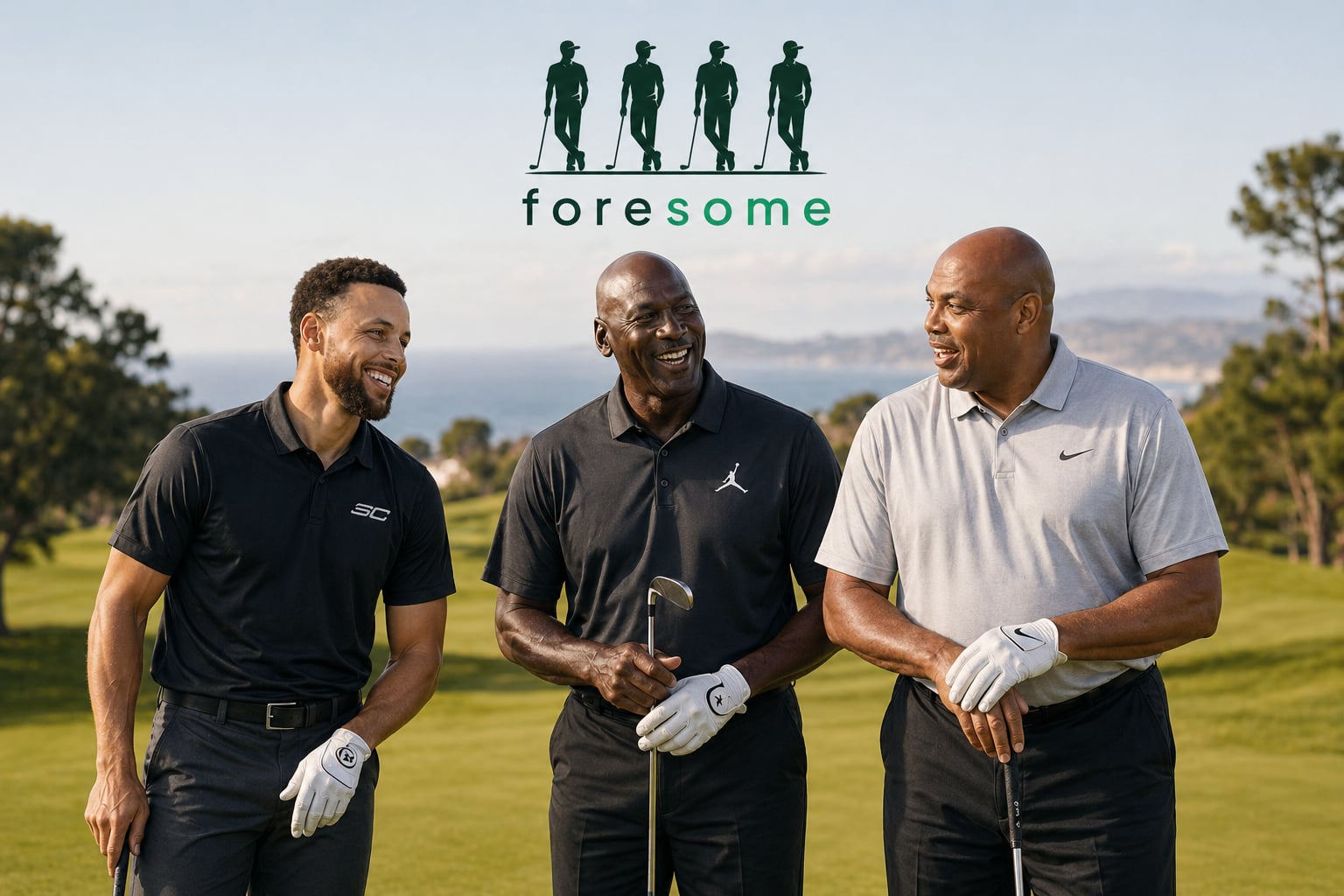
Steph, MJ, JT, Griffey, and Gretzky on one side. Barkley, LeBron, Ovi, J.J. Watt, and Bill Murray on the other. Why retired athletes can't put the game down, and which celebrity swings actually hold up to scrutiny.
There is a long-standing tradition in professional sports, one that doesn't appear in any rulebook or playbook, that goes something like this: the moment a professional athlete retires, sometimes long before, they discover golf. Not casually. Not occasionally. Obsessively. Completely. With a dedication that frankly their coaches probably wish they had directed toward film study.
And who could blame them? Golf is, at its core, a sport built for the competitive soul that can no longer compete. It is merciless, it is humbling, and it will never, ever be truly mastered. For someone who spent thirty years pushing the human body to its outer limits, golf offers something almost perversely perfect: a new mountain to climb, but one made entirely of grass and impossibility, set against the most beautiful backdrops the natural world has to offer.
The morning light on a fairway still has the same magic whether you're a first-time hacker or a three-time champion. The mist sitting in the valley off the 6th hole doesn't care who you used to be. And the silence of early morning on a golf course. Before the carts start humming and the laughter starts carrying across the holes, there is the kind of quiet that reminds even the most decorated athlete that they are, out here, just a person with a club and a dream. That pull is universal. That pull doesn't let go.
But not all athletes make the transition equally. And the swing eye test, my friends, does not grade on a curve just because you have a championship ring.
Why Athletes Flock to the Course The psychology of it makes complete sense. Elite athletes are wired for mastery, for measurable progress, for the specific pleasure of doing something well through sheer repetition and will. Golf gives all of that. Slowly, begrudgingly, and with spectacular emotional punishment along the way. It also gives something team sports rarely do: a stage that is entirely yours. No teammates to lean on. No defense to blame. Just you, the club, the ball, and whatever the wind decides to do that particular afternoon.
Then there's the setting. When you've spent the better part of a decade playing inside a stadium under artificial light or on frozen rinks or on asphalt, stepping onto a golf course for the first time feels like being let out of school early on a Friday. The emerald green of a well-kept fairway. The way a course moves through its natural terrain. Tucking around trees, rising and falling with the land. The smell of early morning dew burning off in the sun. The sound of a perfectly struck iron. Golf lives outdoors, and for athletes who have spent so much of their careers under roofs and inside arenas, the sheer scope of the natural world offered by a golf course is its own reward. You could shoot a twelve and still want to come back. The scenery alone earns that.
The Athletic Advantage and the Athletic Disadvantage Here's where it gets interesting, because not all athletic bodies translate to the golf swing with equal grace.
Basketball players may be the best natural converts to golf of any sport. The reasons are not hard to find. They are tall, flexible, and deeply accustomed to hand-eye coordination at the highest possible level. A basketball player understands the mechanics of controlling a ball with finesse, of touch, of reading trajectories in real time. They understand how to use their legs as the engine of a movement rather than just for locomotion. The footwork, the rotation through the hips, the softness of the hands. It's all transferable in ways that would delight a golf instructor. Watch a good basketball player pick up a club for the first time and there's an ease to it, a naturalness, that most people never find.
Soccer players bring a similar gift. Athleticism is their currency. Their bodies are trained for endurance, for explosive rotational movement, for technical precision in a small window of time. Balance, footwork, and the ability to read a moving environment. These things show up in a golf swing in beautiful ways.
Hockey players arrive with something possibly even more valuable: muscle memory. Gripping and driving a stick, generating power through the core and shoulders, striking a small fast-moving target with precision. The golf swing and the hockey shot share more DNA than you'd expect. The wrists are already trained. The focus is already sharpened. The hardest thing about golf for a hockey player might just be the pace, because golf is slow in ways that the ice never is, and standing still has its own kind of difficulty.
Baseball players may have the single most direct muscle memory advantage of any sport. A left-handed pull hitter taking a full swing at a high fastball is doing something biomechanically not entirely unlike a golf swing. The rotational mechanics, the hip drive, the shoulder turn, the hands releasing through the hitting zone. A baseball swing and a golf swing are kissing cousins. The difference is that in golf, the ball is stationary, which sounds like an advantage until you realize that it gives you absolutely nothing to react to and all the time in the world to think. And thinking, as any golfer will tell you, is the enemy.
Football players are where the love story gets complicated. The athleticism is unquestionable, but the instinct in football is to generate maximum brute force. Explosion, contact, power, these are the currencies of the sport. Golf does not reward brute force. Golf rewards controlled force, which is a completely different thing, and re-training a body and a nervous system built for violence to instead produce something graceful and precise takes real work. The one exception? Quarterbacks. A quarterback already lives in the world of touch, timing, and precision under pressure. They understand trajectory, they understand finesse, and they have hands trained to do exactly what their minds tell them to. It tracks, then, that Tony Romo played well enough in Pro-Am events to make other professionals mildly uncomfortable, and that Aaron Rodgers looks far more competent on a tee box than any defensive lineman who ever threw on spikes.
The Top 5 Celebrity Swings That Pass the Eye Test
-
Steph Curry: The man is a +1.3 handicap, which means he is technically better than a scratch golfer. Let that sink in. He has won the American Century Championship with a walk-off eagle. The kind of finishing moment that makes even professional golfers lower their sunglasses and take a second look. Butch Harmon, one of the greatest instructors who has ever lived, called him an incredibly talented golfer with tremendous natural ability. Curry's swing is compact, athletic, balanced, and driven by body rotation the way every good golf instructor has ever dreamed of. He initiates from the torso, not the arms. His tempo is silky. He has been playing since he was ten years old. His father Dell brought him and his brother Seth along to courses growing up in North Carolina. Every one of those years shows. This is not a celebrity playing golf. This is a golfer who happens to also play basketball.
-
Michael Jordan: MJ's golf game is almost as famous as his basketball career, which is either deeply impressive or slightly insane depending on your perspective. With a handicap that has hovered around 2, Jordan has owned the Grove XXIII, an ultra-exclusive private course in Florida that he essentially built so he could play golf exactly when and how he wanted to, with the competitive intensity of someone who once called a 45-point deficit a challenge rather than a loss. His swing is not effortless in the way Curry's is, it has a certain tenacity to it, a Jordan-ness. It is sound, repeatable, and backed by thousands of hours of work and an obsessive competitive drive that has made golf legends nervous to tee off with him. Pro golfers dread facing Jordan in a match. That tells you everything.
-
Justin Timberlake: JT has a single-digit handicap, has played the AT&T Pebble Beach Pro-Am, and once owned a golf course in Memphis, Tennessee, because when you love the game that much you stop renting and start buying. His swing is smooth, well-coached, and passes every visual test. This is a man who understands rhythm for a living, and rhythm is, at its core, what a good golf swing is. It shows.
-
Ken Griffey Jr.: The Kid's swing in baseball was widely considered the most beautiful in the history of the sport. Smooth, effortless, with a violent follow-through that somehow still looked casual. His golf swing, naturally, carries echoes of that same grace. He plays to a 4.7 handicap and has walked inside the ropes at the AT&T Pebble Beach Pro-Am alongside legends of the game. The rotational mechanics from his baseball swing transferred beautifully. They were always going to. A swing that good doesn't entirely go away just because you change the tool.
-
Wayne Gretzky: The Great One is honest about his limitations on the course. "I'm not very good," he'll say with a grin. The eye test tells a different story. His swing is smooth, balanced, and technically correct in the ways that matter most. He plays three rounds a week. He has a hole-in-one. He won The Match: Superstars in 2024, defeating Charles Barkley in the semifinals and Michael Phelps in the final. His son-in-law is Dustin Johnson. He is, in other words, thoroughly embedded in the world of golf, and you can see that immersion in the way he moves through a course. Comfortable. Unhurried. At home.
The Top 5 Celebrity Swings That Fail the Eye Test, Spectacularly
-
Charles Barkley: Where do we even begin? Sir Charles has the most documented, most analyzed, most lovingly mocked swing in the history of celebrity golf. It comes in three distinct parts: backswing, inexplicable pause, and then a violent lurch through the ball. The pause is the part that haunts dreams. Tom Watson once said he had the yips on the downswing, which is a thing Tom Watson had never seen before and hopefully never wishes to see again. A Nike commercial was built around it. Barkley himself has said he once got a tip from a teacher to pause at the top, and the swing has simply never recovered. The truly remarkable thing about Charles Barkley is not that his swing is bad. It is spectacular in its badness, a swing so uniquely wrong that it has become, in its own strange way, iconic. You can't take your eyes off it. For all the wrong reasons.
-
LeBron James: LeBron is, by any reasonable measure, one of the greatest athletes who has ever lived. His body is a monument to physical preparation and elite coordination. And yet. The golf swing that LeBron has been rolling out at public events and, memorably, on the Lakers bench during games, is…there is a gentle way to say this…”a work in progress”. A very early-stage work in progress. Steph Curry, who has watched him develop, was characteristically encouraging: "There's something to work with that swing, though." When Steph is being encouraging about your swing, you know where you are in the journey. LeBron brings the full force of his competitive will to everything he does, and given enough time and ten thousand range sessions, he will almost certainly get there. He is not there yet.
-
Alexander Ovechkin: Ovi is the greatest goal scorer in NHL history. His slap shot is a weapon of organized destruction. He is a man who has spent his entire career generating maximum force in explosive short bursts, which is exactly the opposite of what golf rewards. His golf swing looks like a man trying to score a goal on the course itself. There is effort. There is commitment. There is a complete and total absence of tempo. The golf swing is going to humble Alexander Ovechkin for a long time, and given that the man feeds on being underestimated, we cannot wait to watch him prove us wrong. For now, he fails the eye test. Emphatically. Lovingly. Loudly. Worth mentioning, has hit a hole in one.
-
J.J. Watt: Jon Rahm, who has won major championships and knows a thing or two about what a good golf swing looks like, once named J.J. Watt, as one of the worst celebrity golfers he has ever played with. The culprit, as with most football players, is the instinct for pure, unmitigated force. J.J. Watt spent fifteen years in the NFL being paid to destroy things. The golf swing is asking him to not destroy anything. This is a difficult adjustment.
-
Bill Murray: Bill Murray is technically a reasonably decent golfer, putting him on this list is a moral obligation because no list of celebrity golf swings is complete without him. Murray does not so much swing a golf club as negotiate with it. He has been known to adjust his stance three or four times, address the ball from angles that defy conventional geometry, and then make some form of contact that produces an outcome that is entirely unpredictable, to himself as much as anyone else. The swing doesn't fail the eye test so much as confuse it. Baffle it. Haunt it gently. And then make it laugh until it cries, which is really all any of us are here for.
The Dwyane Wade Exception And then there is Dwyane Wade, who deserves his own paragraph and possibly a small ceremony.
Flash has been putting in his work on the golf course with the same quiet determination he once brought to guarding point guards and hitting fadeaway jumpers in the fourth quarter. He and LeBron have been spotted practicing their swings at public events, on charity courses, and…in one of the more delightful moments in recent sports memory, conducting informal swing analysis on the Lakers bench during an actual game, which suggests that the obsession had reached a point where even NBA basketball could not fully command their attention.
Wade's defining golf moment arrived on the seventh hole at Pebble Beach. The legendary par-3 that has humbled professionals, caused grown men to weep, and offered the Pacific Ocean as a relentlessly unsympathetic backdrop to human failure. On a misty Friday morning, Dwyane Wade striped a tee shot at that iconic hole, holding his follow-through. The mark of a man who believed in what he'd just done. He watched the ball roll into the cup for his first hole-in-one. He sprinted up a nearby hill in celebration. He screamed. He ran back down. He basked. "I've been waiting on this hole for three years," he said, grinning the grin of a man who had been putting in the work when nobody was watching and finally had the universe acknowledge it.
A hole-in-one at the seventh at Pebble Beach. Pebble Beach. Hole seven. That is not luck. That is the golf gods honoring someone who took the game seriously enough to deserve a miracle.
The Eye Test Looks Back at You Here is the part nobody tells you when you first pick up a club. The swing eye test doesn't just run one direction. You are not only watching others and passing judgment. You are, at some point, going to be the one under observation. And the observer is going to be you.
There will be a day, or perhaps it has already arrived, when someone points a camera at your swing. Maybe it's a friend on the range who thinks they're being helpful. Maybe it's your own phone propped up against your golf bag. Maybe it's one of those awful slow-motion apps that reveals, in merciless clinical detail, everything you believed about your own swing that is demonstrably not true.
And in that moment, watching yourself swing for the first time on video, something happens that no other experience in sport quite replicates. Every golfer alive has experienced the profound disconnect between how their swing feels and how it looks. In your mind you are, frankly, beautiful. You have a good tempo. Your backswing is full, your transition smooth, your impact position solid. You feel like Freddie Couples moving through a Sunday afternoon.
Then you watch the video.
The swing that greets you on that screen was not what you had in mind. The swing on that screen appears to have been produced by someone having a mild argument with the club. The swing on that screen does not, to be completely honest, pass the eye test. The swing on that screen. There is no more appropriate word for this. It does not pass the eye test by a significant margin.
This is golf welcoming you to its permanent residence in your soul.
The Obsession That Never Ends & Why That's the Point Here is the deepest truth about golf, the one that explains why retired athletes don't just pick it up but are consumed by it, why the weekend golfer still talks about that round they played in the fall of 2019 when everything came together for nine glorious holes, why the game has held its grip on human beings for over five hundred years.
Golf cannot be mastered. Not by anyone. Not ever.
Tiger Woods, the greatest golfer who has ever lived, has spent decades rebuilding his swing. Multiple times. Looking for something more, something better, something more perfect. Rory McIlroy locked himself in a basement simulator in New York to fix a swing he'd been using to win professional golf tournaments at the highest level in the world. The pursuit never ends, not because the players aren't good enough, but because the game keeps moving. Because we keep moving.
We are always changing. Physically. The body you had at 25 is not the body at 45 is not the body at 65, and the swing must adapt to every version of it, gracefully or otherwise. Mentally. The thoughts you bring to the first tee are never the same twice, and the voice in your head between shots is not reliably your friend. Emotionally. Some days the game flows through you like music, and other days it feels like the game is actively, personally, specifically opposed to you.
Beyond all of that: every day is different. The weather shifts. A good wind on the back nine becomes a headwind on the front. The pin placement moves three inches to the right and suddenly a hole you've played a hundred times feels entirely foreign. The company you're playing with changes the rhythm of your thinking. A good lie in the rough and a bad lie can be three feet apart. Golf presents the same course on a different day and it is never, ever the same course.
This is golf's most beautiful secret, and it is an almost perfect metaphor for the life we are all living. No two days are identical. The variables are endless. Progress is real but never final. Mastery is always one round away and always slightly out of reach. The best we can do is show up, adjust, adapt, and keep swinging.
The retired athlete who discovers golf doesn't find a lesser game than the one they left. They find a different kind of game. One played in the open air, under moving skies, in the company of friends and the occasional spectacular silence. One that rewards patience, punishes arrogance, and offers, on its very best days, moments of such pure beauty that you forgive it instantly for all the other days.
The obsession is not a bug. That's the whole point.
Never. Stop. Playing.
Written by
Barrett Edri
Co-Founder, Foresome